
Please Choose Your Language
Views: 0 Author: Site Editor Publish Time: 2026-05-20 Origin: Site


Manufacturers often market borosilicate glass as an indestructible wonder material. However, maker communities and industrial buyers regularly debate its actual physical limits. This contradictory messaging creates confusion when you need reliable components. To make smart procurement choices, we must separate the concept of material "safety" into two distinct categories. First, we look at chemical toxicity, where the material proves exceptionally safe. Second, we examine physical breakability, where it remains vulnerable to specific mechanical stresses.
This transparent, evidence-based guide evaluates the reality behind the material. We will explore its molecular chemistry, thermal capabilities, and mechanical weaknesses. You will learn how to identify quality sheets, avoid catastrophic handling failures, and calculate true return on investment. Whether you engineer 3D printers, build lab equipment, or source industrial sight glasses, this breakdown provides the actionable data you require.
Chemical Safety: Borosilicate is completely non-toxic, non-porous, and FDA/ISO-compliant; boron compounds are permanently locked within the molecular matrix.
Physical Reality: It is highly resistant to thermal shock but is not shatterproof. Mechanical impacts will break it into sharp shards, unlike tempered glass.
Implementation: Success depends on usage. Micro-scratches from metal tools (like putty knives) compromise structural integrity over time.
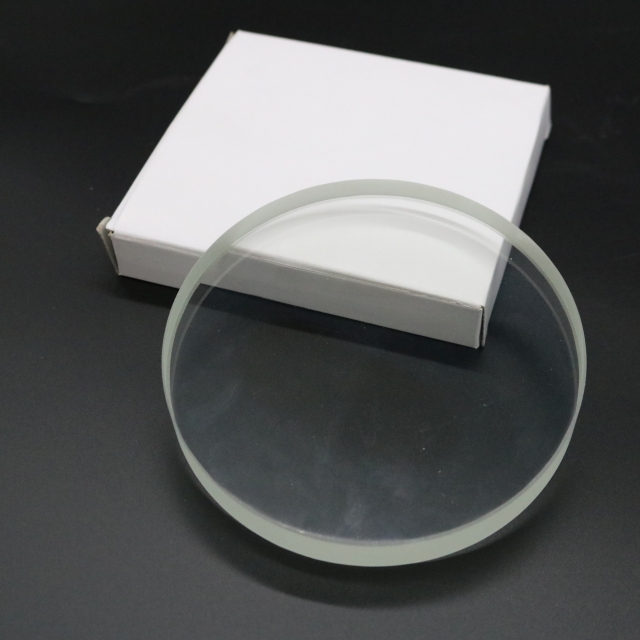
Sourcing Focus: When procuring specific formats—such as a Round Borosilicate 4.2 Glass Sheet for hardware or 3D printing—evaluating edge finishing and dimensional tolerance is just as critical as the material itself.
Addressing compliance, health, and degradation concerns is a primary business problem for engineers. When you build food-grade appliances, design medical devices, or construct high-temperature industrial pipelines, material degradation is unacceptable. You must guarantee your chosen material will not leach toxins into the environment.
The secret to this material's safety lies in its molecular stability. High-quality borosilicate glass contains roughly 12 to 15 percent boron trioxide. Pure boron on its own carries toxicity risks. However, the high-heat manufacturing process creates a "lock-in" effect. The glass matrix binds the boron compounds permanently. This fusion prevents any chemical leaching. Even under extreme UV exposure, highly acidic environments, or intense heat, the molecular bonds hold firm.
We see this safety validated by rigorous global standards. The Cosmetic Ingredient Review (CIR) expert panel has extensively tested these glass structures for biomedical applications, confirming they are non-toxic to human cells. Furthermore, compliance frameworks like ISO 3585 dictate strict chemical resistance guidelines. Manufacturers use this standard to ensure the glass withstands prolonged exposure to corrosive elements.
There is one important heavy metal caveat you must remember. Clear borosilicate is purely safe and free of toxic additives. Buyers sourcing vintage cookware or artificially colored glass must exercise caution. Legacy manufacturers often used lead or cadmium coatings to achieve bright reds and greens. If you require absolute safety for modern industrial or consumer applications, always specify uncolored, clear formulations.
To prevent misapplication and product failure, you must clarify the boundaries of the material's physical capabilities. Marketers frequently label these products as "shatterproof." This leads to dangerous operational assumptions. You must separate thermal resilience from mechanical strength.
Thermal shock supremacy is a scientific reality. Standard soda-lime glass cracks when one section heats up faster than another. The heated section expands, creating immense internal tension. Borosilicate prevents this through an exceptionally low coefficient of thermal expansion (3.3 × 10⁻⁶ K−1). It survives rapid temperature swings of up to 330°F (170°C). You can pull a component from a freezer and plunge it into boiling water without warping or cracking.
Impact resistance is an entirely different story. The objective truth is simple: it breaks. The material possesses high compressive strength but poor tensile strength. Dropping it on a concrete floor will shatter it. Applying uneven mechanical leverage—such as tightening a mounting screw too firmly on one corner—will snap the sheet instantly.
You must also plan for specific shatter pattern risks. When physical tempered glass breaks, internal stress forces it to crumble into safe, blunt cubes. Borosilicate breaks chemically. Because it lacks that internal physical tension, a heavy impact shatters it into sharp, jagged shards. You must enforce proper safety protocols when handling large panels.
Thermal Limit: Easily tolerates 330°F rapid temperature differentials.
Impact Limit: Highly vulnerable to point-impacts from hard surfaces (concrete, steel).
Leverage Limit: Will snap under uneven torque or unbalanced mounting pressure.
Failure Mode: Fractures into dangerous, razor-sharp pieces requiring careful cleanup.
Analyzing the material in a specific operational context reveals its true value. Engineers frequently deploy this glass in 3D printer heated beds, industrial sight glasses, and high-precision optical platforms. In these environments, material format and geometry dictate success.
Format matters heavily when balancing thermal mass and structural rigidity. A Round Borosilicate 4.2 Glass Sheet provides an ideal geometric distribution. The circular shape eliminates the concentrated corner stresses found in square alternatives. Meanwhile, the 4.2mm thickness offers the perfect thermal mass. Thinner glass bows under the tension of shrinking plastics, while thicker glass wastes energy during the heating cycle.
We can look at the feature-to-outcome relationship in a 3D printing context:
Feature: Zero thermal warping at temperatures exceeding 110°C.
Outcome: You achieve perfect first-layer adhesion because the bed remains micro-flat.
Feature: Low thermal expansion coefficient.
Outcome: Automatic part release. As the plastic part cools and shrinks, the glass underneath remains dimensionally static. This mismatched contraction causes the part to pop off safely.
Scalability requires strict sourcing criteria. Do not evaluate the raw material alone. You must shortlist suppliers capable of delivering exact specifications. Look for verified boron ratios to ensure true thermal resistance. Demand polished edges to prevent handling injuries. Finally, insist on exact dimensional tolerances, as a warped surface defeats the purpose of buying high-grade glass.
Real-world failure points gathered from hardware forums and maker communities provide valuable lessons. Users rarely experience failures due to thermal limitations. Instead, user error and improper handling protocols cause the vast majority of broken components.
The micro-scratch threat represents the biggest hidden danger. End-users frequently use metal tools, like spatulas or putty knives, to scrape residue off the surface. These tools create microscopic surface abrasions. While the glass looks intact, these invisible scratches become critical stress-concentration points. When the glass undergoes future heating cycles, thermal tension hunts for the weakest structural link. The glass will suddenly shatter, seemingly without cause, days or weeks after the scratch occurred.
Edge vulnerability is another critical implementation risk. Raw cut glass edges are highly susceptible to chipping. A tiny impact on a raw edge propagates cracks through the entire sheet. You must prioritize edge sanding. Better yet, source a pre-beveled Round Borosilicate 4.2 Glass Sheet to prevent both handling injuries and premature edge failure.
You must establish strict operational protocols for your team. Always allow the glass to cool naturally to room temperature. Forced cooling with damp cloths or compressed air pushes the material beyond its thermal limits. Furthermore, mechanical prying drastically reduces the component's lifespan. Let physics do the work through natural thermal contraction.
Use only plastic or silicone scrapers to remove debris.
Never apply direct leverage to the center of the glass while the edges are clamped.
Clean the surface with isopropyl alcohol when cold to prevent micro-fissures.
Sand any accidentally chipped edges immediately to stop crack propagation.
Project constraints usually force a choice between borosilicate, tempered glass, and standard soda-lime glass. Understanding how to shortlist these materials protects your budget and prevents catastrophic operational failures.
You can perform a visual and physical triage quickly. Use the "edge test" to verify supplier claims. When you look at the edge of standard soda-lime glass under natural light, you will see a distinct blue-green tint. High-quality borosilicate appears completely clear. This simple test prevents you from paying premium prices for standard materials.
Total Cost of Ownership (TCO) and ROI drivers vary wildly. Borosilicate costs roughly 20 to 50 percent more upfront. This premium stems from rare raw materials. Boron accounts for barely 0.001 percent of the earth's crust. Additionally, fusing the matrix requires significantly higher furnace temperatures, driving up energy costs.
However, the trade-off justifies the expense. The TCO is substantially lower for high-thermal applications. Soda-lime glass will crack repeatedly under rapid heating, requiring constant replacement and causing operational downtime. Tempered glass handles physical impacts beautifully but cannot be custom-cut, drilled, or altered post-manufacture. Borosilicate offers the perfect middle ground for custom, high-heat environments.
Application Need | Recommended Material | Primary Trade-off |
|---|---|---|
Extreme heat and chemical resistance | Borosilicate Glass | Higher upfront cost; breaks into sharp shards |
Physical impact safety (doors, windows) | Tempered Glass | Cannot be cut or drilled after manufacturing |
Budget-friendly static storage | Soda-Lime Glass | Will crack easily under rapid temperature shifts |
Borosilicate glass delivers unmatched thermal stability and chemical purity, but it demands realistic physical handling. It is an investment in dimensional accuracy rather than an indestructible miracle material. By understanding its molecular chemistry and its mechanical limits, you can integrate it successfully into your most demanding projects.
Your next-step actions should focus on auditing your primary operational stressors. Identify whether your project primarily faces heat fluctuations or blunt-force impacts. If thermal stability and absolute flatness dictate your success, finalize your operational dimensions and source a precisely cut Round Borosilicate 4.2 Glass Sheet with verified edge-finishing. Train your team on micro-scratch prevention and eliminate metal tools from your workflow to maximize the lifespan of your investment.
A: No. Unlike tempered glass, it breaks into sharp, jagged shards. It is chemically safe, but physical breakage requires careful cleanup.
A: Look at the edge under natural light. Standard soda-lime glass will have a blueish-green tint, whereas high-quality borosilicate appears completely clear.
A: It is highly discouraged. Metal tools cause micro-scratches that weaken the structural integrity, making the glass susceptible to shattering under future thermal stress.
A: Boron is a less common element, and the glass requires significantly higher furnace temperatures to melt and form, driving up manufacturing and energy costs.


